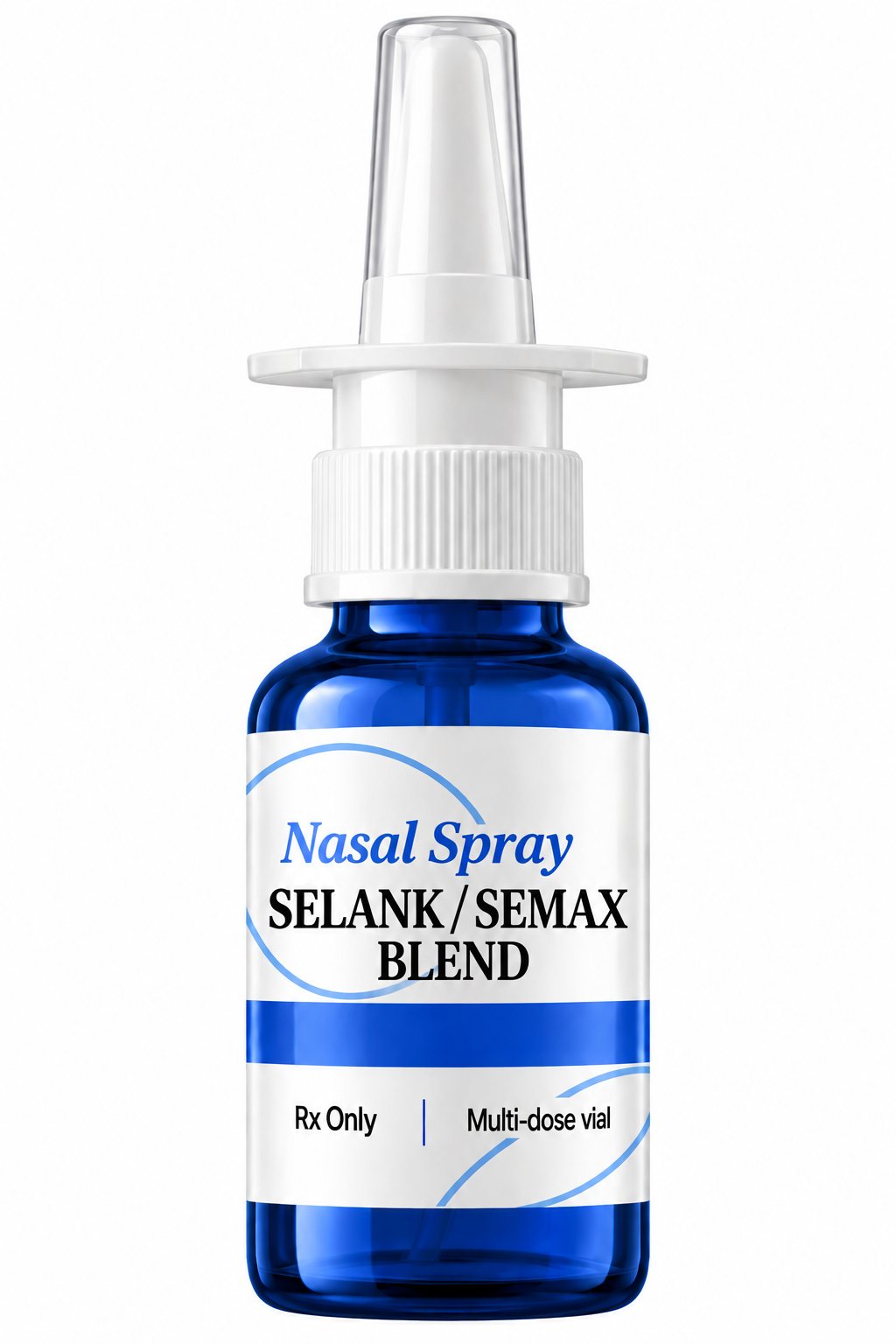
The Brain on Peptides:
Two Peptides Changing the Conversation
Around Anxiety, Focus & Brain Health
Selank and Semax are drawing attention for a reason. With clinical histories abroad and emerging research into anxiety regulation, neuroplasticity, BDNF, cognition and brain resilience, these two peptides offer a fascinating look at where neuroscience may be heading next.
For decades, conversations about mental health have revolved around a familiar group of neurotransmitters: serotonin, dopamine, norepinephrine and GABA.
They’re important. But neuroscience has moved beyond the idea that mental health can be explained by simply having “too much” or “too little” of one neurotransmitter.
The brain is a network.
How neurons communicate, how different regions connect, how the brain responds to stress and how neural connections adapt over time all influence how we think, focus, remember and respond emotionally.
That broader understanding has created growing interest in regulatory peptides—including Selank and Semax.
Both were developed and studied extensively in Russia. Both are synthetic seven-amino-acid peptides with effects on the central nervous system. But they approach brain function from different directions.
Selank has primarily been studied for anxiety, stress regulation and cognitive function under stress.
Semax has primarily been studied for neuroprotection, neuroplasticity, cognition and neurological recovery.
Put more simply:
Selank may help quiet the noise. Semax may help strengthen the signal.
And the science behind that distinction is particularly interesting.
SELANK: Anxiety Relief Without Simply Sedating the Brain?
Selank is a synthetic analog of tuftsin, a naturally occurring immunoregulatory peptide.
Unlike many compounds currently circulating in the American peptide world, Selank was developed as a pharmaceutical drug and has an established history of medical use in Russia.
Official Russian prescribing information classifies Selank as an anxiolytic and lists indications including anxiety, panic attacks, neurasthenia, mood instability, sleep disturbances, adjustment disorders and stress-related conditions.
That doesn’t make it FDA-approved—it isn’t.
But it does distinguish Selank from a compound whose reputation exists primarily on internet forums.
What Does the Human Research Show?
One particularly interesting clinical study involved 62 patients with generalized anxiety disorder and neurasthenia.
Thirty received Selank and 32 received medazepam, a benzodiazepine-class anti-anxiety medication.
Using established psychiatric measures, researchers reported that Selank and medazepam produced similar anxiolytic effects.
Selank was also associated with antiasthenic and psychostimulant effects.
That’s potentially important because reducing anxiety without compromising alertness or cognitive performance remains an important therapeutic goal.
Sometimes you want the brain to stop worrying about the meeting.
You don’t necessarily want it to sleep through the meeting.
This was a small study, however, and shouldn’t be interpreted as establishing that Selank is equivalent or superior to benzodiazepines. Larger independent trials are needed.
How Might Selank Work?
One important pathway involves GABA, the brain’s primary inhibitory neurotransmitter.
Healthy brain function requires a balance between excitatory and inhibitory signaling. GABA essentially helps provide the nervous system’s braking mechanism.
Research suggests Selank can influence the GABAergic system, including receptor-related signaling and expression of genes involved in GABA neurotransmission.
But Selank doesn’t appear to behave simply like a conventional GABA-enhancing sedative.
Researchers have also investigated its relationship with enkephalins—naturally occurring opioid peptides involved in stress adaptation, emotional regulation and pain perception.
In clinical research, patients with anxiety disorders demonstrated altered enkephalin activity, and Selank treatment was associated with changes in this system alongside improvements in anxiety symptoms.
This raises an intriguing possibility:
Selank may influence regulatory systems that help the nervous system respond more appropriately to stress rather than simply suppressing nervous-system activity.
SEMAX: More Than a “Focus Peptide”
Semax is frequently described online as a peptide for focus.
Scientifically, that description doesn’t quite capture it.
Semax is derived from a fragment of adrenocorticotropic hormone (ACTH) but modified so that it doesn’t produce ACTH’s conventional hormonal effects.
Its clinical history in Russia has focused heavily on neurology, neuroprotection and ischemic stroke, rather than simply enhancing concentration in healthy adults.
And one of the most interesting areas of Semax research involves BDNF.
BDNF and Neuroplasticity
Brain-derived neurotrophic factor (BDNF) helps support neuronal survival, synaptic function and neuroplasticity.
Neuroplasticity is essentially the brain’s ability to modify its connections in response to experience.
Learning requires it.
Memory requires it.
Recovery following neurological injury requires it.
And impaired neuroplasticity is increasingly being investigated in several psychiatric conditions.
Experimental research suggests Semax can influence BDNF and its TrkB receptor system, making it an intriguing compound for researchers interested in how the brain adapts and repairs itself.
Importantly, there are human data as well.
Semax, BDNF and Human Neurological Recovery
A clinical study involving 110 patients recovering from ischemic stroke examined Semax, rehabilitation, BDNF levels and functional recovery.
Patients receiving Semax demonstrated increased plasma BDNF concentrations.
Higher BDNF was associated with functional improvement, and researchers reported that Semax administration was associated with faster improvement and better outcomes on the Barthel Index, a standardized measure of independence in daily activities.
This doesn’t establish Semax as a treatment for ADHD, depression, brain fog or cognitive aging.
Stroke rehabilitation and everyday cognitive optimization are very different clinical questions.
But it does provide human evidence connecting Semax, BDNF and neurological recovery—which makes its neuroplasticity story considerably more compelling than simply calling it a “focus peptide.”
What Happens When Researchers Actually Look at the Brain?
Researchers have also investigated Selank and Semax using functional MRI.
In one study, 52 healthy participants received Selank, Semax or placebo while researchers examined resting-state functional connectivity.
Of particular interest were brain networks involving the amygdala, which participates in threat detection and emotional processing, and the dorsolateral prefrontal cortex, which is heavily involved in working memory, executive function and cognitive control.
Researchers detected changes in functional connectivity after peptide administration, including both shared and peptide-specific patterns.
Why is that interesting?
Because anxiety and cognition aren’t independent systems.
When threat circuitry becomes excessively active, executive function can suffer.
Most of us have demonstrated this without an MRI.
You can know someone’s name perfectly well for three years and forget it instantly when asked to introduce them to a room full of people.
The information didn’t disappear.
Stress temporarily changed your ability to access it.
Selank vs. Semax
Although frequently discussed together, these peptides shouldn’t be viewed as interchangeable.
SELANK
Research has focused on:
- Anxiety and stress regulation
- GABAergic signaling
- Enkephalin regulation
- Emotional regulation
- Cognitive performance during stress
- Anxiolytic effects without conventional sedation
SEMAX
Research has focused on:
- Neuroplasticity
- BDNF signaling
- Neuroprotection
- Learning and memory
- Executive function
- Neurological recovery
- Brain-network connectivity
A more useful distinction than simply “calming versus stimulating” may therefore be:
Selank appears particularly interesting when excessive stress signaling interferes with brain function.
Semax appears particularly interesting when researchers are looking at the brain’s ability to adapt, connect and recover.
Why the Intranasal Route?
Both peptides are strongly associated with intranasal administration.
The brain is protected by the blood-brain barrier, which does an excellent job keeping unwanted substances away from delicate neural tissue.
Unfortunately, it’s equally enthusiastic about keeping many potentially useful therapeutic molecules out.
The nasal cavity provides access to pathways associated with the olfactory and trigeminal nervous systems, which is why “nose-to-brain” delivery has become an active area of pharmaceutical research.
This concept extends far beyond Selank and Semax and is being investigated for multiple neurological diseases.
The nose, apparently, has a more impressive résumé than we gave it credit for.
What About Mental Health?
This is where the science becomes particularly compelling—and where we need to distinguish evidence from extrapolation.
For Selank, there is direct human research involving anxiety disorders.
For Semax, the strongest clinical evidence remains primarily neurological, particularly stroke and rehabilitation research. Its potential applications to cognition and mental health are less established.
But both intersect with biological systems increasingly relevant to modern psychiatry:
Stress circuitry. GABA signaling. Neuroplasticity. BDNF. Executive-function networks. Emotional regulation. Neuroimmune signaling.
This matters because the future of mental-health treatment may involve much more than adjusting the concentration of an individual neurotransmitter.
Beyond the “Chemical Imbalance” Era
Perhaps the most compelling thing about Selank and Semax isn’t either peptide individually.
It’s what they represent.
Mental health is increasingly being viewed through systems biology rather than a single chemical imbalance.
Researchers are asking bigger questions:
- Can we improve neuroplasticity?
- Can we strengthen adaptive stress responses?
- Can we influence neurotrophic signaling?
- Can we improve communication between emotional and executive brain networks?
- Can we regulate nervous-system activity rather than simply suppress it?
Selank and Semax offer intriguing clues about what that future could look like.
Instead of asking only how we can change the chemicals in the brain, neuroscience is increasingly asking how we can help the brain communicate, adapt and regulate itself more effectively.
That’s a much bigger question.
And these two small peptides are helping make it an increasingly interesting one.
The East Cobb Wellness Perspective
At East Cobb Wellness, we’re interested in emerging science without pretending that “emerging” means “settled.”
Selank and Semax have published human research, compelling biological mechanisms and histories of clinical use outside the United States.
The goal isn’t to chase every molecule trending in the wellness world.
It’s to understand what the research shows, where it’s strongest, where it remains preliminary and how emerging therapies may fit into a thoughtful, individualized approach to wellness.
Because when it comes to the brain, perhaps the more interesting question is no longer:
“Which neurotransmitter are we trying to change?”
But:
“How do we help the brain become better at regulating itself?”
This article is intended for educational purposes only and does not constitute medical advice. Selank and Semax are not FDA-approved in the United States for the treatment of anxiety, depression, ADHD or other psychiatric disorders. References to foreign registration, clinical use or published research should not be interpreted as establishing FDA approval, safety or efficacy for an individual patient.